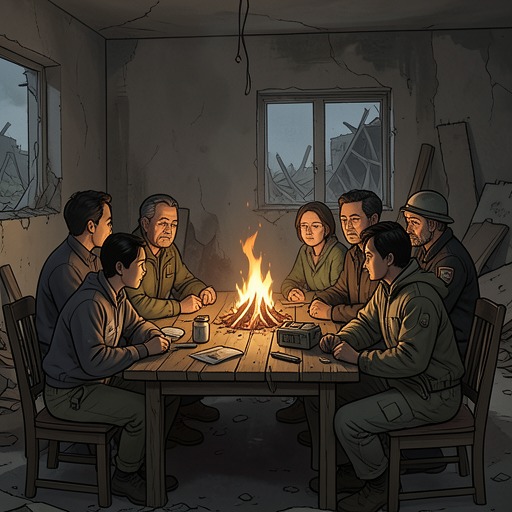
Year of the Fires
Earth AbidesYear of the Fires, or Year 3, marks a prolonged wildfire crisis in the survivors’ calendar and a stark example of how the landscape had been reshaped by human activity. The fires were not simply a natural disaster: logging, earlier human-caused fires, and the end of active fire suppression had left forests unusually vulnerable to a dry season and lightning.
Chronology and Naming
The fires came in the community’s third year. The preceding year had been remembered as the Year of Ezra, named in memory of a visitor who had left and whom the group did not expect to see again. Year 3 acquired its own name after smoke began drifting over the area just after mid-summer and continued, at varying intensity, for three months. The naming makes the fires a defining event in the community’s reckoning of time, rather than an isolated disturbance without a place in its shared history.
Causes and Course
Ish recognized that the western forests were no longer the old-growth woodlands of large trees, where a fire might pass without causing extensive damage. Logging and human-started fires had produced dense second-growth, thick with highly flammable growth, slash piles, and brush fields. That landscape depended on people to suppress fires; after the disaster, hoses remained coiled and bulldozers stood unused, leaving the forests without the intervention on which their altered condition relied.
The summer was very dry across northern California. Lightning-set fires therefore moved unchecked through the tangled second-growth and ignited tinder-dry slash piles. For one particularly frightening week, fires were visible at night along the north side of the Bay, climbing mountain slopes from bottom to top and continuing until there was nothing left to burn. The smoke’s persistence and the fires’ reach made the crisis a regional process unfolding over months, not just a brief outbreak.
Geographic Limits and Aftermath
The broad arms of the San Francisco Bay helped contain the fires on the northern side. No lightning storms started new fires south of the Bay, and the natural division limited the disaster’s spread in the area Ish observed. This boundary offered some protection, but it did not lessen the scale of the fires to the north.
Afterward, Ish believed that very few forests in California had escaped burning and that centuries would be needed for them to grow again. The estimate presents the damage as a lasting ecological change: the fire season had consumed a landscape already made more combustible by human use, while the people who once maintained its defenses were gone.
Life During the Year
The year also records a change in Ish’s own adjustment to life after the disaster. He settled into reading, taking books from the City Library while keeping the million volumes of the University Library as a reserve for a later time. Although he thought he ought to study practical subjects such as medicine, agriculture, and mechanics, he found himself drawn instead to the history of humanity: anthropology, history, philosophy, novels, poems, and plays. Set beside the fires, this turn toward books links the year’s physical devastation with Ish’s effort to understand the human past and adapt to a world from which its institutions and protections had disappeared.